Wednesday, June 4, 2014

US ITC Injunction Reform Efforts

In Ben Sitkoff’s guest post in the Patently-O blog titled “PatentReform 2014: Removing Non-Practicing Entities from the USITC’s Jurisdiction,” he discusses a recent bill introduced in the House of Representatives, which aims to prevent non-practicing entities (NPEs) from using the International Trade Commission as a venue for patent disputes.

As background, the ITC is responsible for rulings regarding the importation of goods into the United States, and may prevent the importation of items that infringe US patents, trademarks, or copyrights. In order to create an injunction through the ITC, a plaintiff in the ITC must prove that there is a domestic industry protected by that IP.

Before 2006, injunctions were a common damage awarded to NPEs in federal courts, causing substantial damage to the practicing entity, and incentivizing practicing entities to settle cases. However, after the eBay v. MercExchange case, obtaining injunctions in District Court became more difficult, especially for NPEs. The ITC, on the other hand, injunctions are still common, with winning complainants automatically receiving an importation ban against at least the parties found to infringe.

In order for an NPE to win an injunction through the ITC, however, it must, as previously stated, prove that there is a domestic industry in products protected by the patents the defending parties are infringing upon. While the most obvious case of this would be the complainant making a product protected by a patent and the respondents importing devices that infringe that patent, complainants could also prove that they had made substantial investments to license other parties to their patents, or that people who have licenses also have products that practice the asserted patents.

This House bill aims to reform NPE’s abuse of ITC injunctions by revising this proof requirement to be more stringent. However, it has several immediate problems regarding its language.
1.      It aims to modify the ability to rely on licensing by replacing “licensing” with “substantial investment in licensing activities that leads to the adoption and development of articles that incorporate the patent, copyright, trademark, mask work, or design.” The issue with this phrasing is that “articles that incorporate the patent” has no clear meaning in case law, while “incorporate the… copyright” leaves the meaning of “incorporate” ambiguous.
2.      The bill aims to target a recent rule making change in the ITC which allow a preliminary investigation with respect to the domestic industry. However, the short-description of the bill, and the bill itself, disagree on the timing. While the one-pager limits this preliminary investigation to 45 days after it has been started, the actual bill limits this investigation to no later than 45 days after the filing of the complaint. The ITC has historically only initiatied their investigations after the complaint has been filed for thirty days. Furthermore, 45 days is less than half the time the ITC had previously alloted for these investigations. Overall, this 45 day limit severly handicaps parties’ ability to conduct discovery, submit briefing, hold a preliminary hearing, and issue a written opinion within either 45 days of filing, or even 45 days after a prelimary investigation was initiated.
3.      Even in cases where a complainant fully proves their case, the ITC may choose not to implement an injunction in the interest of the public. This has occurred traditionally in cases wehre public safety and welfare would be endangered by importation bans; however, this bill expands the public interest to include competitive competitions in the US. The implication of this is that, while patent trolls may be hindered from preventing companies from importing, the ITC’s Administrative Law Judges may be reluctant to apply the traditional “public interest” guidelines to consumer luxury goods.


At a high level, this bill succeeds in being the first step in reforming the relationship between patent trolls, importation bans, and the ITC. However, Sitkoff pokes some very valid holes into the wording of the bill, citing some ambiguous language, overly zealous time restrictions, and ambitious definitions as reasons for its potential failure. I think that the bill, having not yet passed the Senate, has plenty of time for revision, and look forward to tracking the progress of the bill as it continues its development.

I further discuss my thoughts on this topic at the following link:
https://www.youtube.com/watch?v=fbTXHBVsuHY

Patent Indefiniteness and Ambiguity Changes

In his Patently-O post titled “Supreme Court: To Be Valid,Patent Claims Must Provide Reasonable Certainty Regarding the Claim Scope,” Dennis Crouch discusses the indefiniteness of patents, or requirements regarding what a patent infringement would entail. He states that a patent claim that fails the indefiniteness test would be unpatentable, invalid, and unenforceable.

While most patent claims have some ambiguity, Crouch questions: how much ambiguity is too much? In the past, the Federal Circuit had implemented a rigid indefiniteness test, making it difficult to find a claim invalid due to it being indefinite. Recently, however, the Supreme Court found that “insolubly ambiguous” claims fail to apply, and would therefore count as indefinite.

As a result, the Supreme Court has created a new test for patents’ indefiniteness, as follows: “A patent is invalid for indefiniteness if its claims, read in light of the specification delineating the patent, and the prosecution history, fail to inform, with reasonable certainty, those skilled in the art [at the time the patent was filed] about the scope of the invention…”

I think that it is particularly interesting that the Supreme Court chose to relate patent indefiniteness to the knowledge of one skilled in the art. By implementing this definition, they constrained the scope of patent claims to mitigate any intentionally confusing or vague claim language.


The Supreme Court cited its justification for this new definition of indefiniteness to be the old rule’s incentivization of patentees to intentionally “inject ambiguity into their claims.” We had discussed this tactic in class, and I believe that, while allowing patents to cover more scope and increase their monetization potential, this tactic allowed patent trolls to easily create suits without basis.

I further discuss my thoughts on this topic at the following link:
https://www.youtube.com/watch?v=aKNGwHNeBSE

Wednesday, April 30, 2014

IEOR 190G Reflection: Social Media Use

I found this class's emphasis on the utilization of blogs and YouTube videos to be both beneficial and cumbersome.

Writing the blog was an interesting exercise every week. It facilitated our learning and digestion of the material, while serving as an externally visible piece of work that we could show to interested parties. Overall, I found that making each week's deliverable two blogs posts was a good way to facilitate our knowledge of intellectual property issues and news. On the other hand, I did not find our YouTube channels to be very instructive. While it may have been helpful for other students in helping them to practice their public speaking skills, I personally felt comfortable delivering my YouTube videos in one run through, and did not find them helpful from a personal or professional development standpoint.

I have a similar response to the comments on other students' blogs and videos that we wrote every week. I did find it interesting to read other students' blogs, and found that commenting on them was a useful way to give and receive feedback on our ideas and perspectives. Commenting on other students' YouTube videos, however, was cumbersome and difficult. I found that it was difficult to provide feedback on the videos due to the length of the videos and the structure that most students, including myself, utilized in the videos, and that I usually had to refer to the related blogs in order to fully understand what most people were saying. While I could see the value that these comments provided, I feel that the same feedback regarding content could be provided in a more structured and concise manner by commenting on the related blog posts.

Utilization of blogs and YouTube is definitely a departure from the traditional learning tools of lectures, homework, and tests that most classes utilize. I found that this class structure did result in me putting in more effort each week, and that I will most likely retain the information better as a result. However, I found this structure to be repetitive after a while, due to the straightforward and structured nature of each blog post and video. If I had to do this class all over again, I would improve by investing more time into each blog post, ideally being able to pull from multiple sources to discuss different perspectives on each issue.

I further discuss my thoughts on this topic at the following link:
https://www.youtube.com/watch?v=qq4U-pigxlI

IEOR 190G Reflection: Class Experience

My semester taking IEOR 190G was extremely useful in helping me to understand the intellectual property landscape and strategies that patent holders use. The class covered both elements in depth, and was helpful in giving me both a broad perspective on the patent landscape as well as giving me a deep understanding of the tactics that intellectual property owners utilize.

The smartphone patent war, patent litigation court choices, the tactics of non-practicing entities, and the details of patent claims and applications were all covered in this class, with an emphasis on the role that such concepts have on companies' intellectual property decisions and tactics. I was particularly interested in the role that patent claims have in determining a patent's viability as an offensive and defensive strategy were, due to the strategic choices that must be made in making a patent broad or specific.

This knowledge is important to me as I believe that it will be useful from a career perspective. I would like to either work at or found a startup in the future, and believe that protecting my intellectual property will be crucial to the success of that endeavor. This class was successful in providing a foundation upon which to build that knowledge, and I definitely feel that I learned more about the patent litigation landscape as a result of the class.

I further discuss my thoughts on this topic at the following link:
https://www.youtube.com/watch?v=OQCw8Gcj9-g

Sunday, April 27, 2014

Silly Patents: Apparatus for Simulating a "High Five"

US Patent #5,356,330 covers an apparatus that can be used to simulate a "high five". In simpler language, it is a fake arm with a readjusting elbow joint that allows high fivers to practice their high five-ing technique independently of a friend or acquaintance. A diagram of the patent is included below:

I found this patent particularly interesting due to its cited background. I have provided its full text for the purposes of added humor below: 
"During a televised sporting event, a "high five" is commonly shared between fans to express the joy and excitement of a touchdown, home run, game-winning basket, birdie or other positive occurrence. Unfortunately, as known in the art, a "high five" requires the mutual hand slapping of two participants, wherein a first participant slaps an upraised hand against the elevated hand of a second participant. As such, a solitary fan is unable to perform a "high five" to express excitement during a televised sporting event."

Another interesting feature of this patent is its prior art citations, which come from a variety of different sources. From a self-erecting football dummy to a "doll giving particular vocal responses on movement of particular appendages", each citation seemed to come from a different industry, but I could see how they all had an effect on the patent's novelty.

I further discuss my thoughts on this topic at the following link:
https://www.youtube.com/watch?v=cbut22dJJSQ

Saturday, April 26, 2014

Silly Patents: The Cane with Three Flasks


In this blog post, I'll be discussing an interesting patent that I discovered on the blog site Patently Silly, which contains a database of "silly" patents. The patent covers a walking cane that has three flasks built into it. I have included a picture of it below.

Cane
This patent was awarded in 2004, under patent number 6,745,785. If you're interested, you can read the full text of the patent here: http://patft.uspto.gov/netacgi/nph-Parser?Sect1=PTO1&Sect2=HITOFF&d=PALL&p=1&u=%2Fnetahtml%2FPTO%2Fsrchnum.htm&r=1&f=G&l=50&s1=6745785.PN.&OS=PN/6745785&RS=PN/6745785

The patent has a total of 12 claims, overall discussing the structure, materials, and shape configuration of the cane. In addition to being a "silly" invention, I found that the patent was not well written because of this reason. The claims covered within the patent are too specific, covering the specific configuration that the pictured cane's flasks are in. As a result, if, for example, I invented a cane that has four flasks contained within it, I would not be infringing on this patent. The specificity of this patent therefore prohibits it from having any real value as a revenue generating patent with which the owner could sue infringing parties, as the likelihood of a flask cane manufacturer adopting the specific configuration that is discussed in the patent is minimal.

Another point of interest that I found regarding this patent was the wide variety of prior art sources that it listed. On first thought, I would have assumed that such a patent would have minimal prior art references, due to the absurdity and novelty of the idea. However, this patent cited 15 previous domestic patent documents as prior art, in addition to 6 foreign patent documents. Furthermore, many of these prior art sources were extremely old, including patent number 26,721, which was filed in January of 1860.

Overall, this three-flask cane was an interesting case study in the importance of keeping claims broad enough to be meaningful, as well as demonstrating the amount of thought that must be put into trivial device patents.

I further discuss my thoughts on this topic at the following link:
https://www.youtube.com/watch?v=3pwB-JAorbg

Friday, March 21, 2014

What were the implications of KSR International vs. Teleflex?

For this blog, I looked at an analysis of the KSR International vs. Teleflex case that we had discussed at the end of class on Monday 3/17, which was published by the John Marshall Law School in 2007. As a landmark case in determining what it means to be obvious, it was informative in helping to see what the grey areas might be in defining obviousness.

Some of the more interesting points that the analysis touched on are as follows:
·        What impact the Supreme Court’s KSR decision has on district courts’ processes to decide obviousness challenges. It could be read to suggest that the Supreme Court and the lowerfederal courts may have different ideas concerning how obviousness should be decided as a procedural matter
·        What obviousness can be defined by. The article cites potential sources of information as the scope and content of the prior art, differences between the prior art and the patent claims, and the level of ordinary skill in the relevant field. It also expounds on secondary considerations.
·        When permitting the jury to decide the question of obviousness is wrong. The article’s authors suggest that the ultimate judgment of obviousness is a legal determination, and that the court is to make various determinations. Its most extensive discussion is as follows: “Often, it will be necessary for a court to look to interrelated teachings of multiple patents; the effects of demands known to the design community or present in the marketplace; and the background knowledge possessed by a person having ordinary skill in the art, all in order to determine whether there was an apparent reason to combine the known elements in the fashion claimed by the patent at issue.”

The article recommends that the best way to “tee up” an obviousness case is for either the defendant or plaintiff to move for summary judgment. The court will either grant the motion, in which case there will be no trial on obviousness, or deny the motion, in which case it must in theory have done so because there are disputed issues of underlying fact. The article then elaborates on what might happen in either of these scenarios: if the motion is denied, each side should determine what factual issues are identified as being in dispute, and from there decide whether to propose jury questions or a general verdict.

I think this article did a great job discussing the implications of obviousness decisions for court cases. We had yet to determine what they might be for plaintiffs and defendants in such cases, and how the logistics of those suits might play out. One thing that I would like to learn more about is what the next steps that a defendant or plaintiff in a case that argues obviousness might be, both in and out of court, as we have yet to discuss this.

I further discuss my thoughts on this topic at the following link:
https://www.youtube.com/watch?v=SbH7xw-JDec

The Definition of Obviousness

In his blog post titled “United States: Patent Law 106: When Is An Invention Obvious And When Is It Patentable?” Ryan L. Marshall discusses Section 103 as it pertains to the definition of obviousness. It prohibits patents “if the differences between the subject matter sought to be patented and the prior art are such that the subject matter as a whole would have been obvious at the time the invention was made to a person having ordinary skill in the art to which said subject matter pertains." In essence, this defines what obviousness means.

In addition to covering the definition of obviousness as we had discussed in class, the article specifically elaborated on evidence that inventors can use to support the nonobviousness of an invention. Referred to as “secondary considerations”, this can include:
·         the commercial success of products or processes arising from the invention,
·         long-felt but unsolved needs that are met by the invention,
·         failure of others to solve problems the invention achieves, and
·         unexpected results and superior properties imparted by practicing the invention.
One or more of these secondary considerations can be persuasive enough for a patent office or court to affect their decision.

The article also discussed the ambiguity of what “ordinary skill in the art” might mean. It compares “unpredictable” fields such as chemical and cosmetic arts, in which success is less obvious and people with ordinary skill in the art might not realize that the product will be successful, to more predictable fields requiring less skill where obviousness is more commonly determined.


Overall, I find Marshall’s summary of obviousness to be informative and an appropriate summary of Section 103. I think it would have been more interesting if he had gone into greater depth regarding how each of the secondary considerations might play into patent granting decisions, as I feel that they each might have a different weight.

I further discuss my thoughts on this topic at the following link:
https://www.youtube.com/watch?v=HiGn_Vw6RCw

Friday, March 7, 2014

Samsung's Successful Defense in Korea

On Wednesday, February 26, the [South] Korean Fair Trade Commission ruled against Apple’s compaint against Samsung. In 2012, Apple had asserted that Samsung was misusing standard-essential patents for 3G technology, stating that the patents were supposed to be licensed under fair, reasonable, and non-discriminatory (FRAND) terms. The KFTC responded to these assertions by saying that Samsung’s court actions do not break Korean antitrust law.

This decision runs counter to identical investigations conducted by agencies in other countries. Both the U.S. Department of Justice and the European Commission have voiced their concern over Samsung’s potential abuse of FRAND patents.


I had discussed Apple’s ongoing litigation against Samsung in a previous blog post, wherein I expounded on the Department of Justice’s decision to drop a similar investigation of Samsung, potentially as a form of foreign policy. It appears that the KFTC’s decision may have had more of a basis to throw out this claim, compared to its US and EU counterparts, as it may have determined that Samsung does not have monopoly power, due to over 50 companies holding a plethora of 3G-related SEPs. 

I further discuss my thoughts on this topic at the following link:
https://www.youtube.com/watch?v=1y8EXrjPS30

IPCom’s unsuccessful German litigation

Last Friday, February 28th, the German Mannheim Regional Court threw out three cases filed by “patent troll” IPCom, which had filed complaints against Apple and HTC.  With two suits filed against Apple and a third against HTC, IPCom had aimed to monetize its patents purchased from Bosch involving 3G/UMTS wireless technology. The decisions to throw out these cases was made in three separate rulings by the aforementioned court, with IPCom’s Bosch patent portfolio covering standard-essential patents (SEPs) being involved in each one.

IPCom is a non-practicing IP licensing firm, which explicitly states on its website: “Our core business is the global licensing of patents from our own portfolio to producers in industry.” The firm has been comparatively unsuccessful in its legal recourses, but was successful in winning a settlement from Deutsche Telekom in 2013.

This case study in patent troll litigation is indicative of the larger issues at work. The FOSS Patents blog also covered this court decision, wherein author Florian Mueller discussed Apple’s historic success against patent trolls in Germany due to its repeated use of successful law firm Freshfields Bruckhaus Deringer. Mueller also highlights IPCom’s ongoing issues regarding its patent portfolio, in that many large manufacturers are working to invalidate various patents.

I further discuss my thoughts on this topic at the following link:
https://www.youtube.com/watch?v=1bWxfnU5p4E

Friday, February 21, 2014

The U.S. Department of Justice drops its investigation of Samsung

Florian Mueller, author of the Foss Patents blog, wrote in his blog post titled “Samsung to U.S. appeals court: Presidential veto not broad enough to protect Apple once more” about the ongoing injunction suits that Samsung has been filing against Apple in the United States, and the Department of Justice’s recent decision to drop its investigation of Samsung. He asserts that the U.S. Department of Justice (DoJ) has been too lenient with Samsung, based on the response of European courts to Samsung’s suits. Mueller also feels that the DoJ’s leniency towards Samsung has been guided by foreign policy decisions, rather than a straightforward application of the law.

The impetus for Meuller’s discussion of this topic is the DoJ’s closing of its investigation of Samsung’s use of FRAND-pledged standard essential patents, or SEPs, against Apple two weeks ago, in early February 2014. Because of the Obama administration’s veto of an import ban that Samsung had won against Apple last year, the Antitrust Division had determined that “no further action [against Samsung] was required at this time.”

Mueller highlights Samsung’s patent litigation strategy in Europe, and compares it with their American strategy. In Europe, Samsung had dropped its SEP-based injunction requests against Apple, in order to settle with the European Commission and avoid or minimize fines. Mueller states that the U.S. DoJ should have expected Samsung to similarly withdraw its requests for for injunctive relief against Apple regarding US SEPs, and only then be willing to close its investigation of Samsung.

Overall, Mueller believes that Samsung’s legal strategy is to demonstrate that it can win an import ban on remand, should the appeal succeed on liability. He believes that the DoJ shouldn’t have closed its investiation of Samsung without the latter withdrawing its appeal, as it had in Europe.

My take on Mueller’s analysis is that it is valid, but does not discuss the other side of the equation; Apple’s ongoing suits against Samsung. Discussion of Apple’s suits against Samsung would have provided a broader context for the DoJ’s decision, as well as framed Samsung’s strategy in a more well-balanced manner.

I further discuss my thoughts on this topic at the following link:
https://www.youtube.com/watch?v=URHjGyuHRVE

Differences in IP Litigation Court Choices: Patent, Copyright, and Trademark Suits

In his post to Patently-O titled “Disjunction in IP Litigation: Patent Courts are not Copyright Courts”, law professor Dennis Crouch explores the difference in court selection preferences that occurs between the various types of intellectual property suits: patent, copyright, and trademark infringements.

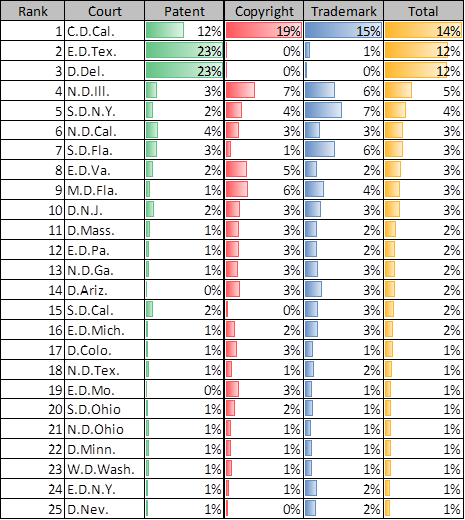
Overall, Crouch finds that the most popular patent infringement jurisdictions are among the least popular jurisdictions for copyright and trademark suits, with patent litigation cases also being more highly concentrated in a smaller number of jurisdictions.

For example, the top three patent jurisdictions handle 59% of patent cases, while the top three copyright and trademark jurisdictions handle 32% and 28%, respectively. Crouch asserts that the reason for this concentration is that NPE cases generally cluster, as they usually involve a single plaintiff filing against multiple defendants before a single court.

Refer below to a table showing the relative frequency of the different types of IP cases handled in various districts, courtesy of LexMachina.


Crouch also finds that appellate courts have a greater disparity in the types of intellectual property suits that they handle. Almost all patent litigation appeals are heard by the Court of Appeals for the Federal Circuit, while the same court handls very few copyright or trademark infringement actions. Conversely, the appellate courts that hear the most copyright and trademark appeals almost never hear patent appeals.

I find that Crouch’s assertions are valid, backed by hard data and analysis. I think that an additional reason for the disparity in court preferences that occurs between the different types of IP litigations may be because the American populace is more likely to be familiar with a product’s copyright or trademark, but not its patents. As a result, juries are more likely to be familiar with or understanding of the specific copyright or trademark suit that a plaintiff files, compared to a patent suit. Plaintiffs will therefore not benefit from an uneducated jury in a copyright or trademark case as compared to a generally complex patent case, resulting in their willingness to select other federal districts in an effort to take advantage of some other local advantages.

I further discuss my thoughts on this topic at the following link:
https://www.youtube.com/watch?v=-RWTHVEJjTo

Friday, February 14, 2014

Patent Litigation Trends and Court Location Choices

For patent holders, deciding where to file their suit is a decision driven by the intrinsic characteristics of federal district courts. Over time, patent holders, and non-practicing entities specifically, have gotten more sophisticated in picking the locations of their legal battles. Overall, although both achieve two-thirds success rates at trials, non-practicing entities are successful 24% of the time, while practicing entities are successful 34% of the time. In this blog post, I will be exploring the trends in decisions regarding patent litigation suits, as well as the curious trend of patent holders filing their litigation suits in the Eastern District of Texas.

A PWC report on important patent litigation trends in 2013 found evidence that non-practicing entities (NPEs), more colloquially called patent trolls, are generally becoming more successful as time passes. They found that on average, damages awarded to NPEs have more than doubled compared to damages for practicing entities over the last decade, with university/non-profit NPEs having the highest success rates and individuals having the lowest. Furthermore, royalties have consistently remained the primary patent damage award, with 80% of patent litigation awards taking the form of royalties over the past six years.


Certain federal courts are favored by patent holders due to their shorter time-to-trial duration, higher success rates, and larger median damages awards, with the top five federal courts accounting for 39% of all identified decisions involving an NPE as the patent holder. The Eastern district of Texas has generally been the court of choice, with 12% of all NPE decisions occurring there, trials often lasting only a week, and juries that are thought to be inclined towards large verdicts. According to a recent report by the law firm Perkins Cole, 1,260 patent cases were filed in East Texas last year, compared to about 1,000 filed in Delaware, the second most frequent patent litigation court. Defendants there are unlikely to win cases on summary judgement, with judges often deferring to juries to rule on patent issues. This last point is especially salient, as PWC reports that the median jury award was nearly 45 times the median bench award between 2007 and 2012.

I further discuss my thoughts on this topic at the following link:
https://www.youtube.com/watch?v=sRK2BDS0W7Q

Thursday, February 13, 2014

Why Did Google Buy and Sell Motorola?

Google’s decision to first acquire Motorola Mobility, and then sell it off to Lenovo, was effective and well thought out. By gaining control of Motorola’s mobile patents, which are invaluable to Google in its patent defense of the Android operating system, and then selling off Motorola’s unprofitable operations and IP, Google was able to transition from maintaining a defensive stance in the smartphone patent war to being able to prosecute its competitors for patent infringement.

Google acquired Motorola in August 2011, purchasing it for a total of $12.5B USD. At the time, Google justified their acquisition of Motorola by explicitly stating that “Motorola Mobility’s patent portfolio will help protect the Android ecosystem,” among others. At the time, Motorola had $3B in cash, in addition to some 17,000 patents. Google later sold one of its acquired divisions for $2.4B, but had reported operating losses for Motorola totalling ~$1.7B over its lifetime as a part of Google.

Lenovo acquired Motorola from Google for $2.9B in January 2014, to mixed reactions from across the tech sector. Most notable tech reporters and analysts felt that Google had taken large losses on its Motorola acquisition, even though Google retained the majority of Motorola’s all-important patent portfolio. On the other hand, analysts generally felt that Lenovo would become well-positioned to succeed in mobile with the Motorola brand behind it, comparing the acquisition to Lenovo’s purchase of ThinkPad from HP in 2004 for $1.75B, after which Lenovo grew to become the world’s largest PC maker in 2013.

Overall, Motorola remained profit negative under Google, but was heavily restructured, and had its product portfolio simplified and reduced to the Moto X and Moto G. The Motorola that Lenovo purchased includes about 2,000 patents, with Google with the vast majority of Motorola patents for use in its ongoing patent litigation suits.

While Google took a loss in its acquisition and sell-off of Lenovo, the patent portfolio that it is keeping is priceless. Through its Motorola-acquired patents, Google can now more successfully defend the Android ecosystem, increasing the competitiveness of the smartphone operating system marketplace and providing consumers with more choices and options.

I further discuss my thoughts on this topic at the following link:
https://www.youtube.com/watch?v=AX2BndwlDKE

Wednesday, February 5, 2014

The Effect of the Smartphone Patent War on Consumers

The smartphone patent war is an unavoidable result of the patent systems that each company must navigate. In the long-run, it is a necessary business strategy for smartphone companies to engage in, in order to protect and preserve individual companies' intellectual property.

Patent Litigation: A Smart Business Tactic
None of the companies involved in the smartphone patent war would be investing the tens of millions of dollars that they spend on defensive litigation if they had a choice. Each would want to file purely offensive suits in order to protect their IP while preventing others from utilizing it; however, due to the nature of suits, each case must have a defendant. As such, each company in the smartphone industry that claims a reasonable stake must, as a necessity, be involved in patent litigation and defense.

What effect does this have on companies and consumers?
Patent litigation expenses are necessary to protect profits and intellectual property. Without strong IP defense, companies that would normally have monopolies on their product or technology would earn an unjustifiable return on their investments, mitigating the incentives that they have to invent new technologies. With the ability to retain and monopolize IP, companies can reap the full benefits from their investments without facing competition.

Companies will have strong incentives to innovate, invent, and improve with strong IP protection. As a result, consumers will benefit from the improved technologies that such companies will be able to produce. The smartphone patent war is a necessary evil of the industry, and in the long run will result in increased incentives for innovation in the smartphone industry as it sets a precedent for strong IP defense in the future.

I further discuss my thoughts on this topic at the following link:
https://www.youtube.com/watch?v=j1dd0ax_HJ4

The Evolution of the Smartphone Patent War

The smartphone patent war began in 2009. At that time, the iPhone had been in the market for 2 years and Android had been operational for about a year. Nokia’s share price had fallen from its high of ~$40 per share in late 2007 to the $13-$15 range, while Apple and Google's stocks had been steadily rising since late 2008.

The opening salvo of the smartphone patent war was fired by Nokia, who in October of 2009 sued Apple for 10 patents related to the Global System for Mobile communications, wireless local area network, and Universal Mobile Telecommunications System (or GSM, WLAN, and UMTS, respectively). This started off the ongoing trend of suing and countersuing between all of the companies that would enter the smartphone patent war, as Apple would countersue Nokia in December 2009.

In 2010, other players in the smartphone industry began to enter the fray. Apple further sued HTC in March over patent infringements related to iPhone’s iOS user interface, to which HTC would respond with an ITC complaint against Apple in May. Oracle would sue Google over 7 patents related to Java in August 2010 and Microsoft would file an ITC complaint against Motorola in October.


Two notable battles in the smartphone patent war have been between Apple and Samsung, which kicked off in April of 2011, and Google and everybody else. Apple sued Samsung over patent and trademark infringements related to Samsung’s Galaxy line of smartphones and tablets, which it claimed looked suspiciously similar to Apple’s iPads and iPhones. Google has been playing defense ever since it lost to a bid of $4.5B USD on an auction of over 6,000 Nortel mobile-related telecomm patents to its competitors in June of 2011, resulting in its reactive strategy of acquiring patents from IBM and Motorola.

I further discuss my thoughts on this topic at the following link:
https://www.youtube.com/watch?v=TZzOArTmakI

Friday, January 31, 2014

Why I'm interested in IEOR 190G

As I mentioned in my previous blog post, I am interested in the mobile space, having worked with two mobile companies over the past two years. I feel that knowledge of the engineering side of patents will be a useful skill for me to have throughout my career, and would like to gain the skills to analyze patents and help companies through the patent process from an engineering perspective. Additionally, I have heard that this class is interesting and engaging, and as I am in my last semester at Cal, I am focusing on courses that interest me both intellectually as well as professionally.

I further outline my interest in IEOR 190G in the following video:
https://www.youtube.com/watch?v=D7kUkahvDcQ

Introduction

My name is Albert Yam, and I am a fourth year at U.C. Berkeley in the Economics department. I will be graduating in May 2014, and will start working at the market and consumer research firm Nielsen in July, in their San Francisco office. I have worked with a variety of tech companies and nonprofits throughout the Bay Area, most recently at Aarki, a mobile advertising startup that focuses on engaging rich media ad units, where I led our content marketing efforts. Previously, I worked at MindSnacks, a mobile educational game developer, where I led our quantitative marketing analyses.

You can see me further introduce myself via the following link:
http://www.youtube.com/watch?v=pMH9jnWRETQ