Friday, February 21, 2014

The U.S. Department of Justice drops its investigation of Samsung

Florian Mueller, author of the Foss Patents blog, wrote in his blog post titled “Samsung to U.S. appeals court: Presidential veto not broad enough to protect Apple once more” about the ongoing injunction suits that Samsung has been filing against Apple in the United States, and the Department of Justice’s recent decision to drop its investigation of Samsung. He asserts that the U.S. Department of Justice (DoJ) has been too lenient with Samsung, based on the response of European courts to Samsung’s suits. Mueller also feels that the DoJ’s leniency towards Samsung has been guided by foreign policy decisions, rather than a straightforward application of the law.

The impetus for Meuller’s discussion of this topic is the DoJ’s closing of its investigation of Samsung’s use of FRAND-pledged standard essential patents, or SEPs, against Apple two weeks ago, in early February 2014. Because of the Obama administration’s veto of an import ban that Samsung had won against Apple last year, the Antitrust Division had determined that “no further action [against Samsung] was required at this time.”

Mueller highlights Samsung’s patent litigation strategy in Europe, and compares it with their American strategy. In Europe, Samsung had dropped its SEP-based injunction requests against Apple, in order to settle with the European Commission and avoid or minimize fines. Mueller states that the U.S. DoJ should have expected Samsung to similarly withdraw its requests for for injunctive relief against Apple regarding US SEPs, and only then be willing to close its investigation of Samsung.

Overall, Mueller believes that Samsung’s legal strategy is to demonstrate that it can win an import ban on remand, should the appeal succeed on liability. He believes that the DoJ shouldn’t have closed its investiation of Samsung without the latter withdrawing its appeal, as it had in Europe.

My take on Mueller’s analysis is that it is valid, but does not discuss the other side of the equation; Apple’s ongoing suits against Samsung. Discussion of Apple’s suits against Samsung would have provided a broader context for the DoJ’s decision, as well as framed Samsung’s strategy in a more well-balanced manner.

I further discuss my thoughts on this topic at the following link:
https://www.youtube.com/watch?v=URHjGyuHRVE

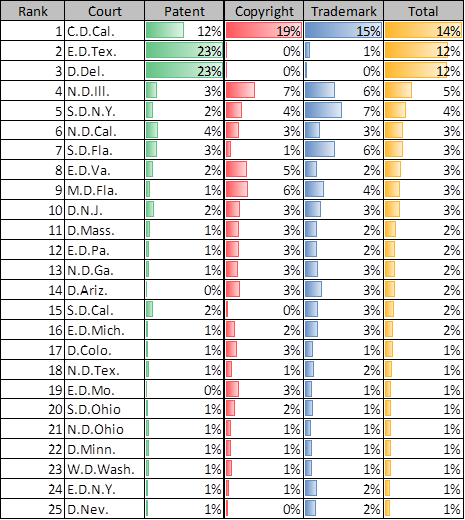
Differences in IP Litigation Court Choices: Patent, Copyright, and Trademark Suits

In his post to Patently-O titled “Disjunction in IP Litigation: Patent Courts are not Copyright Courts”, law professor Dennis Crouch explores the difference in court selection preferences that occurs between the various types of intellectual property suits: patent, copyright, and trademark infringements.

Overall, Crouch finds that the most popular patent infringement jurisdictions are among the least popular jurisdictions for copyright and trademark suits, with patent litigation cases also being more highly concentrated in a smaller number of jurisdictions.

For example, the top three patent jurisdictions handle 59% of patent cases, while the top three copyright and trademark jurisdictions handle 32% and 28%, respectively. Crouch asserts that the reason for this concentration is that NPE cases generally cluster, as they usually involve a single plaintiff filing against multiple defendants before a single court.

Refer below to a table showing the relative frequency of the different types of IP cases handled in various districts, courtesy of LexMachina.


Crouch also finds that appellate courts have a greater disparity in the types of intellectual property suits that they handle. Almost all patent litigation appeals are heard by the Court of Appeals for the Federal Circuit, while the same court handls very few copyright or trademark infringement actions. Conversely, the appellate courts that hear the most copyright and trademark appeals almost never hear patent appeals.

I find that Crouch’s assertions are valid, backed by hard data and analysis. I think that an additional reason for the disparity in court preferences that occurs between the different types of IP litigations may be because the American populace is more likely to be familiar with a product’s copyright or trademark, but not its patents. As a result, juries are more likely to be familiar with or understanding of the specific copyright or trademark suit that a plaintiff files, compared to a patent suit. Plaintiffs will therefore not benefit from an uneducated jury in a copyright or trademark case as compared to a generally complex patent case, resulting in their willingness to select other federal districts in an effort to take advantage of some other local advantages.

I further discuss my thoughts on this topic at the following link:
https://www.youtube.com/watch?v=-RWTHVEJjTo

Friday, February 14, 2014

Patent Litigation Trends and Court Location Choices

For patent holders, deciding where to file their suit is a decision driven by the intrinsic characteristics of federal district courts. Over time, patent holders, and non-practicing entities specifically, have gotten more sophisticated in picking the locations of their legal battles. Overall, although both achieve two-thirds success rates at trials, non-practicing entities are successful 24% of the time, while practicing entities are successful 34% of the time. In this blog post, I will be exploring the trends in decisions regarding patent litigation suits, as well as the curious trend of patent holders filing their litigation suits in the Eastern District of Texas.

A PWC report on important patent litigation trends in 2013 found evidence that non-practicing entities (NPEs), more colloquially called patent trolls, are generally becoming more successful as time passes. They found that on average, damages awarded to NPEs have more than doubled compared to damages for practicing entities over the last decade, with university/non-profit NPEs having the highest success rates and individuals having the lowest. Furthermore, royalties have consistently remained the primary patent damage award, with 80% of patent litigation awards taking the form of royalties over the past six years.


Certain federal courts are favored by patent holders due to their shorter time-to-trial duration, higher success rates, and larger median damages awards, with the top five federal courts accounting for 39% of all identified decisions involving an NPE as the patent holder. The Eastern district of Texas has generally been the court of choice, with 12% of all NPE decisions occurring there, trials often lasting only a week, and juries that are thought to be inclined towards large verdicts. According to a recent report by the law firm Perkins Cole, 1,260 patent cases were filed in East Texas last year, compared to about 1,000 filed in Delaware, the second most frequent patent litigation court. Defendants there are unlikely to win cases on summary judgement, with judges often deferring to juries to rule on patent issues. This last point is especially salient, as PWC reports that the median jury award was nearly 45 times the median bench award between 2007 and 2012.

I further discuss my thoughts on this topic at the following link:
https://www.youtube.com/watch?v=sRK2BDS0W7Q

Thursday, February 13, 2014

Why Did Google Buy and Sell Motorola?

Google’s decision to first acquire Motorola Mobility, and then sell it off to Lenovo, was effective and well thought out. By gaining control of Motorola’s mobile patents, which are invaluable to Google in its patent defense of the Android operating system, and then selling off Motorola’s unprofitable operations and IP, Google was able to transition from maintaining a defensive stance in the smartphone patent war to being able to prosecute its competitors for patent infringement.

Google acquired Motorola in August 2011, purchasing it for a total of $12.5B USD. At the time, Google justified their acquisition of Motorola by explicitly stating that “Motorola Mobility’s patent portfolio will help protect the Android ecosystem,” among others. At the time, Motorola had $3B in cash, in addition to some 17,000 patents. Google later sold one of its acquired divisions for $2.4B, but had reported operating losses for Motorola totalling ~$1.7B over its lifetime as a part of Google.

Lenovo acquired Motorola from Google for $2.9B in January 2014, to mixed reactions from across the tech sector. Most notable tech reporters and analysts felt that Google had taken large losses on its Motorola acquisition, even though Google retained the majority of Motorola’s all-important patent portfolio. On the other hand, analysts generally felt that Lenovo would become well-positioned to succeed in mobile with the Motorola brand behind it, comparing the acquisition to Lenovo’s purchase of ThinkPad from HP in 2004 for $1.75B, after which Lenovo grew to become the world’s largest PC maker in 2013.

Overall, Motorola remained profit negative under Google, but was heavily restructured, and had its product portfolio simplified and reduced to the Moto X and Moto G. The Motorola that Lenovo purchased includes about 2,000 patents, with Google with the vast majority of Motorola patents for use in its ongoing patent litigation suits.

While Google took a loss in its acquisition and sell-off of Lenovo, the patent portfolio that it is keeping is priceless. Through its Motorola-acquired patents, Google can now more successfully defend the Android ecosystem, increasing the competitiveness of the smartphone operating system marketplace and providing consumers with more choices and options.

I further discuss my thoughts on this topic at the following link:
https://www.youtube.com/watch?v=AX2BndwlDKE

Wednesday, February 5, 2014

The Effect of the Smartphone Patent War on Consumers

The smartphone patent war is an unavoidable result of the patent systems that each company must navigate. In the long-run, it is a necessary business strategy for smartphone companies to engage in, in order to protect and preserve individual companies' intellectual property.

Patent Litigation: A Smart Business Tactic
None of the companies involved in the smartphone patent war would be investing the tens of millions of dollars that they spend on defensive litigation if they had a choice. Each would want to file purely offensive suits in order to protect their IP while preventing others from utilizing it; however, due to the nature of suits, each case must have a defendant. As such, each company in the smartphone industry that claims a reasonable stake must, as a necessity, be involved in patent litigation and defense.

What effect does this have on companies and consumers?
Patent litigation expenses are necessary to protect profits and intellectual property. Without strong IP defense, companies that would normally have monopolies on their product or technology would earn an unjustifiable return on their investments, mitigating the incentives that they have to invent new technologies. With the ability to retain and monopolize IP, companies can reap the full benefits from their investments without facing competition.

Companies will have strong incentives to innovate, invent, and improve with strong IP protection. As a result, consumers will benefit from the improved technologies that such companies will be able to produce. The smartphone patent war is a necessary evil of the industry, and in the long run will result in increased incentives for innovation in the smartphone industry as it sets a precedent for strong IP defense in the future.

I further discuss my thoughts on this topic at the following link:
https://www.youtube.com/watch?v=j1dd0ax_HJ4

The Evolution of the Smartphone Patent War

The smartphone patent war began in 2009. At that time, the iPhone had been in the market for 2 years and Android had been operational for about a year. Nokia’s share price had fallen from its high of ~$40 per share in late 2007 to the $13-$15 range, while Apple and Google's stocks had been steadily rising since late 2008.

The opening salvo of the smartphone patent war was fired by Nokia, who in October of 2009 sued Apple for 10 patents related to the Global System for Mobile communications, wireless local area network, and Universal Mobile Telecommunications System (or GSM, WLAN, and UMTS, respectively). This started off the ongoing trend of suing and countersuing between all of the companies that would enter the smartphone patent war, as Apple would countersue Nokia in December 2009.

In 2010, other players in the smartphone industry began to enter the fray. Apple further sued HTC in March over patent infringements related to iPhone’s iOS user interface, to which HTC would respond with an ITC complaint against Apple in May. Oracle would sue Google over 7 patents related to Java in August 2010 and Microsoft would file an ITC complaint against Motorola in October.


Two notable battles in the smartphone patent war have been between Apple and Samsung, which kicked off in April of 2011, and Google and everybody else. Apple sued Samsung over patent and trademark infringements related to Samsung’s Galaxy line of smartphones and tablets, which it claimed looked suspiciously similar to Apple’s iPads and iPhones. Google has been playing defense ever since it lost to a bid of $4.5B USD on an auction of over 6,000 Nortel mobile-related telecomm patents to its competitors in June of 2011, resulting in its reactive strategy of acquiring patents from IBM and Motorola.

I further discuss my thoughts on this topic at the following link:
https://www.youtube.com/watch?v=TZzOArTmakI